


HODA-A™ · One-day masterclass
Clinical Touch
The art and science of active touch
Human perception, measurement, and what the evidence missed. A practical day for clinicians who assess with their hands, about the oldest instrument in clinical practice and the one every hands-on finding passes through. Yours.
The contradiction
Two findings that cannot both be the whole story
68%
Untrained fingertips told apart two surfaces that differed by a single atom, 68% of the time.
Dhong et al., Soft Matter, 2021
70 years
of reliability research concluding that hands-on assessment cannot be trusted, and most recently that it should not be used at all.
The inter-examiner reliability literature, 1950s to today
Both are real findings. Something between them is missing. By the end of this day you will know what it is, and you will have felt it happen in your own hands, twice.
The spine of the day
Whose touch?
In 1962 the psychologist James Gibson drew a line that clinical research has mostly walked straight past. The whole day hangs from it.
Active touch · touching
The clinician's purposeful, exploratory contact, used to gather information.
Palpation as a measurement act. This is where every hands-on assessment lives, and where HODA-A™ sits.
Passive touch · being touched
The patient's experience of being touched, which they do not control.
Sensory, affective and contextual. This is where almost all research on therapeutic touch has been done.
The research talks about therapeutic touch again and again without saying whose. Almost every tool it has produced measures how it feels to be touched. The clinician's touch – the perceptual act that hands-on assessment depends on – has rarely been studied as an instrument at all.
Before we test reliability, we must stabilise the instrument.
The art and the science
Three ideas, each one felt in your own hands
The day alternates between knowing and doing. Each block of science is followed straight away by a block of play, where you test the idea on yourself, against a known answer.
Science
The anatomy of active touch
Where the signal comes from. The receptors in your fingertips, why a still finger feels almost nothing, and what that single-atom laboratory had that your treatment room does not.
Play
Break it, and put it back
In pairs, scored against a known answer. Grade surfaces by feel, then chill your hands, tape your fingertips, change how you explore – and watch your own numbers fall and come back.
Science
The brain that predicts
Perception is not reception. What you feel is a conclusion drawn under uncertainty, weighted by what you expected to find. That is not a character flaw. It is a property of the instrument, and properties can be characterised and controlled.
Play
The expectation experiments
Priming, viewpoint, parallax and position. The same assessment, changed only by what you were told, where you stood and how you held yourself.
Science
Where the evidence went wrong
Seventy years of studies asked whether hands agree. Almost none first asked whether the instrument had been stabilised or checked against a reference standard. Why that happened, and why none of us noticed.
Play
Build a reference standard
Blind, repeated and scored against the truth, with conditions held still. For many clinicians, the first time a hands-on judgement has ever been scored against anything at all.
The principle behind the play
Every break is followed by a restore
None of this is designed to show that touch is unreliable. It shows that human perception is conditional, and that the conditions belong to you. Cold hands feel less; warm them and they feel more. That is not fragility. It is control.
You don't just saunter onto court and smack the first ball, if you're any good. There's a whole process for finding your ready position, finding your balance point.
Expert panel member, Dr Jo Abbott's HODA-A™ doctoral research
The programme
How the day runs
“We'll work in blocks of about forty minutes, because I'm not going to teach you that your own state changes your hands and then ask you to sit still for two hours.”
Dr Jo Abbott
The moving debate
Propositions go up on the wall. You stand under the one you hold, and speak from where you are standing.
- Hands-on assessment should be removed from entry-level curricula.
- We should stop using the word palpation.
- If it cannot be measured, it should not be charged for.
As run at the Massage & Myotherapy Australia National Conference, Cairns. About five teaching hours.
- 10:30Opening: the contradictionWhole room20 min
- 10:50The anatomy of active touchScience40 min
- 11:30Break it, and put it backPlay30 min
- 12:00Morning breakBreak15 min
- 12:15The brain that predictsScience40 min
- 12:55The expectation experimentsPlay30 min
- 13:25LunchBreak45 min
- 14:10Where the evidence went wrongScience40 min
- 14:50Build a reference standardPlay30 min
- 15:20Afternoon teaBreak30 min
- 15:50The moving debateWhole room30 min
- 16:20CloseWhole room25 min
The longer city day adds a final block: you write the three questions you will ask yourself before your next hands-on assessment, and read one aloud.
- 09:30Opening: the contradictionWhole room25 min
- 09:55The anatomy of active touchScience45 min
- 10:40Break it, and put it backPlay35 min
- 11:15Morning breakBreak15 min
- 11:30The brain that predictsScience45 min
- 12:15The expectation experimentsPlay35 min
- 12:50LunchBreak45 min
- 13:35Where the evidence went wrongScience45 min
- 14:20Build a reference standardPlay35 min
- 14:55Afternoon breakBreak15 min
- 15:10The moving debateWhole room35 min
- 15:45Monday morning, and closeWhole room45 min
What you leave with
Something to use on Monday morning
1
Explain the difference between active and passive touch, and why it matters for every hands-on assessment you make.
2
Recognise the states in yourself that change what your hands report, and how each one can be restored.
3
Describe how expectation, viewpoint and position shape a hands-on finding before you are aware of it.
4
Leave with three questions to ask yourself before your next hands-on assessment.
Honest about its limits
What this day is, and what it is not
It is
- A practical day about you as the measurement instrument
- Scored against known answers, not opinions
- Built around research you can check for yourself
- Full of room for questions, disagreement and debate
It is not
- A technique course. No new test is taught
- A promise that your hands will be more reliable by the evening. Nothing in HODA-A™ claims that
- A certification, or a shortcut to one
- HODA-A™ Level 1, which is sixteen weeks for a reason
Where it leads
HODA-A™ Level 1 Perceptual Calibration Certification is sixteen weeks of online, mentored practice, with a toolkit sent to your door. If the day leaves you wanting the rest, that is where it lives.
Practicalities
Simple by design
Who it is for
Massage therapists, myotherapists, physiotherapists, osteopaths, chiropractors, and anyone whose clinical decisions rest on what their hands tell them.
Bring nothing
Everything you use is ordinary and provided on the day: abrasive papers, paper, playing cards and coins. No massage tables are needed.
How you will work
In pairs and small table groups, seated and standing. Wear something comfortable; you will be up and moving through the day.
What you take home
A handout of the day's ideas and sources, and three questions you will use before your next hands-on assessment.
Where and when
2027 dates
Cairns
Queensland, Australia
Saturday 5 June and Sunday 6 June 2027 · the same day, run twice
At the Massage & Myotherapy Australia National Conference. Book through the conference.
Further cities
Australia, New Zealand, Canada
Dates being arranged for 2027
Register your interest below and you will hear first when a day is confirmed near you.
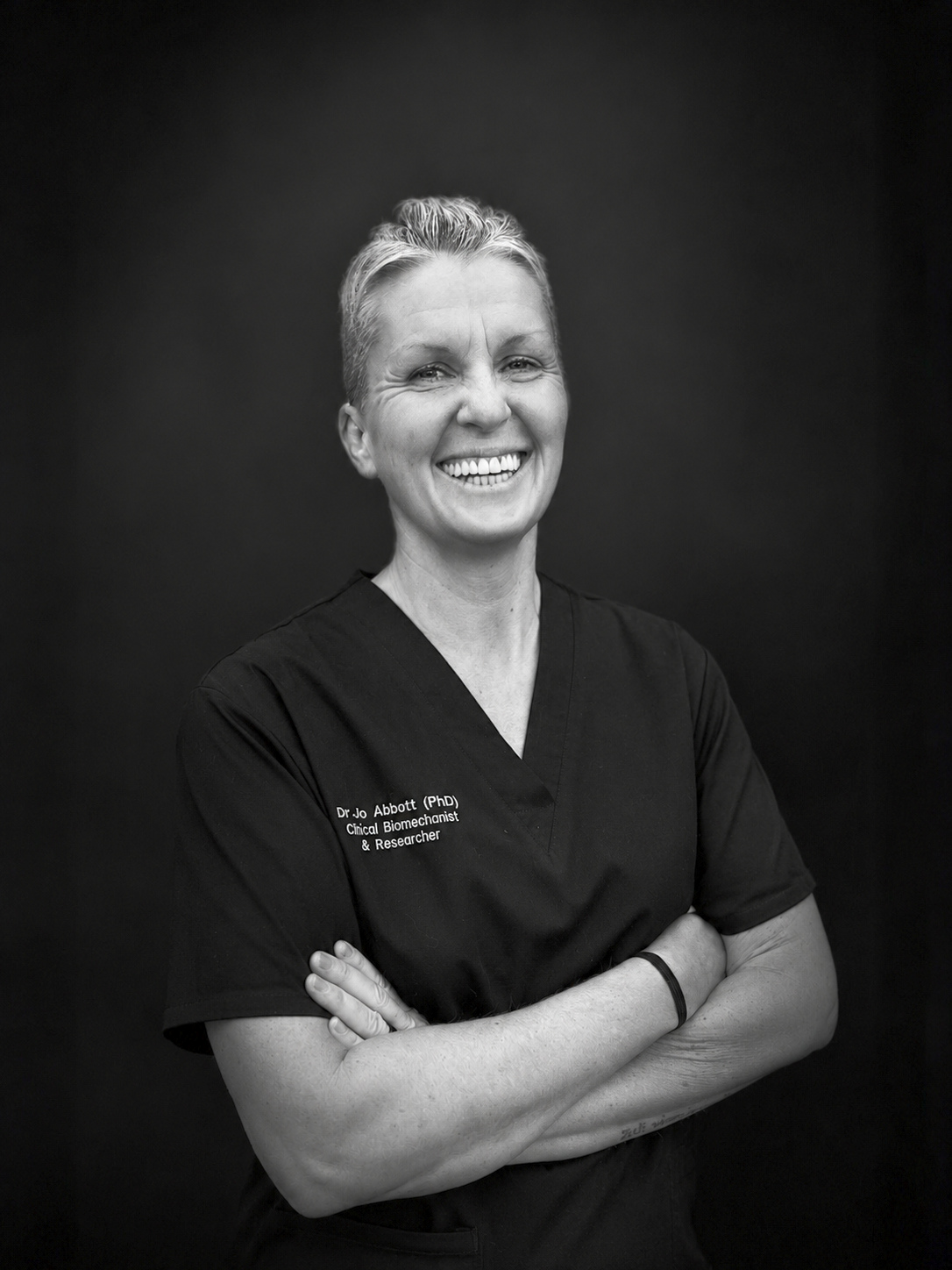
Your host
Dr Jo Abbott, PhD
Clinical biomechanist and independent MSK researcher · Founder of HODA-A™
Dr Jo began in electro-mechanical engineering and has spent more than twenty years in clinical biomechanics, rehabilitation and movement. Her doctoral research asked why hands-on assessment has never been treated as a measurement act, and how the clinician, as the instrument, could be stabilised before reliability is tested.
That work became HODA-A™ (Hands-On Data Acquisition and Analysis), a COSMIN-informed measurement science framework for manual therapy, published in Physiotherapy Theory and Practice in 2026. She is affiliated with the Institute of Applied Sciences at the University of Chichester, and teaches clinicians internationally.
Register your interest
Bring this day to your city, or your team
Associations, universities and clinical teams can host this masterclass. Clinicians can register interest in a day near them. Either way, start with a short conversation.
jo@drjoabbott.com · +44 (0) 800 3800 603